Flip The Switch
A simple, practical approach to calming your nervous system, shifting your perspective, and elevating your mood — starting today.
Introduction
In 1986, at the age of 25, I experienced my first panic attack.
I was sitting on the couch on a Sunday night with my then husband and a friend, casually watching football. There was nothing unusual happening, nothing particularly stressful, and yet out of nowhere my heart began pounding so hard it felt as though it would explode out of my chest. My vision blurred, I felt dizzy and strangely disconnected, as if I had suddenly been sealed inside a bubble that separated me from reality.
I was certain I was having a heart attack, and I was absolutely convinced I was going to die.
My husband rushed me to the emergency room, where the doctors told me my heart rate was 220. Within seconds an oxygen mask was placed over my face and I was injected with medication to slow everything down.
Hours later, highly medicated and deeply shaken, I was sent home in the early morning darkness feeling terrified, confused, and completely convinced there was something seriously wrong with my heart.
What followed were months of medical testing, including echocardiograms, MRIs, and stress tests, yet every single test came back clear.
When I finally met with my doctor to review the results, he told me there was nothing physically wrong with me. He explained that what I had experienced was a panic attack and added, rather casually, that they did not really know what caused them.
He wrote me a prescription for Valium and sent me home.
For a couple of weeks, I took the medication, and while it dulled the fear, it dulled everything else too. I felt numb, flat, and completely unlike myself. I remember realizing that although the anxiety had softened, so had my sense of being me. So I made a decision that felt both brave and terrifying at the same time.
I stopped taking it.
If you have ever experienced a panic attack, you already understand what happened next. The fear of the first attack quickly turns into the fear of the next one, and that fear alone can trigger another. Anxiety begins feeding anxiety, creating a loop that feels impossible to escape. Before long, your world starts to shrink.
Mine certainly did.
I began limiting where I went, what I did, and how far I strayed from anything that felt “safe.” Leaving the house became an ordeal. My husband, who had been supportive at first, gradually grew frustrated and eventually urged me to “just snap out of it,” as though panic were a simple choice.
Of course, panic does not respond to “snap out of it.”
Around that time, while working at a small local newspaper, I noticed a book sitting on a table in a waiting room. The book was The Winner’s Edge by Denis Waitley. I picked it up, brought it back to my desk, and began reading.
One sentence stopped me cold.
“You are in the driver’s seat of your own life.”
That idea jolted me awake because I had never considered that I had any real control over my inner world. I believed life was governed by fate, chance, and circumstances — anything but me.
Yet during that season of my life, something deeper was becoming painfully clear. I was deeply unhappy with myself and my life, I was disconnected from my emotions, and the majority of my thoughts revolved around what was wrong and who was to blame. I hated Arizona. I blamed my husband for moving us there. I felt trapped not only by panic, but by my own thinking.
Inside that book, Denis Waitley talked about affirmations, a concept I had never encountered before. Something about the idea resonated, so I decided to try. I wrote a simple statement on an index card and carried it with me everywhere:
“I am safe in this moment. All is well. My body is strong and healthy.”
Whenever I felt the first whisper of panic — the racing heart, the tightening chest, the familiar surge of dread — I repeated it like a chant. I also began experimenting with slow, deep breathing. I would breathe in through my nose and out through my mouth, deliberately slowing my body down. Sometimes I would intentionally look around my environment, focusing on something solid and real — a tree, a chair, a lamp — to ground myself back in the present moment.
Little by little, something began to change.
Over the course of about two years, the panic attacks became less frequent and less intense until eventually they stopped altogether, and they never came back.
That experience changed the trajectory of my life. It opened my mind to a realization that would shape everything that followed: our thoughts matter. They influence our bodies, they affect our emotions, and they quietly shape the way we experience our lives.
Most importantly, they can be changed gently, gradually, and intentionally.
That period marked the beginning of what has become a lifelong journey of understanding how the mind and body work together and discovering simple, practical ways to regulate emotions, calm the nervous system, and shift perspective.
Over the forty years since that first panic attack, I have gathered, practiced, tested, and refined countless tools for self-regulation and personal empowerment, and this book contains the very best of them.
I wrote it now because even though we understand more than ever about stress, anxiety, and the nervous system, more people than ever are struggling with overwhelm, worry, racing thoughts, and emotional exhaustion.
Even after four decades of doing this work, I still use these tools every single day, not because I am broken, but because I am human.
If you struggle with anxiety, stress, overwhelm, or patterns of thinking that simply do not serve you, I wrote this book for you.
Nothing lights me up more than helping people discover that feeling better is not only possible, it is learnable, and often far simpler than we have been led to believe.
This is where the metaphor of the switch comes in.
Most of us live as though our internal state is controlled entirely by circumstances, other people, stress, the past, or the unpredictable nature of life. We wait to feel better. We hope things calm down. We assume peace will arrive when something outside of us changes.
But there is a switch.
Not a magical one, not an instant “fix everything” button, but a very real capacity within you to influence your nervous system, your emotional state, and the direction of your thoughts. Learning to flip that switch is not about denying reality, forcing positivity, or pretending everything is fine. It is about understanding how your mind and body work, and gently guiding yourself from reactivity toward regulation, from overwhelm toward steadiness, and from autopilot toward conscious choice.
This book will show you how, because you have the power — you hold the switch!
Between what happens and how you respond,
there is a moment...
That’s where your power lives.
That moment is the switch.
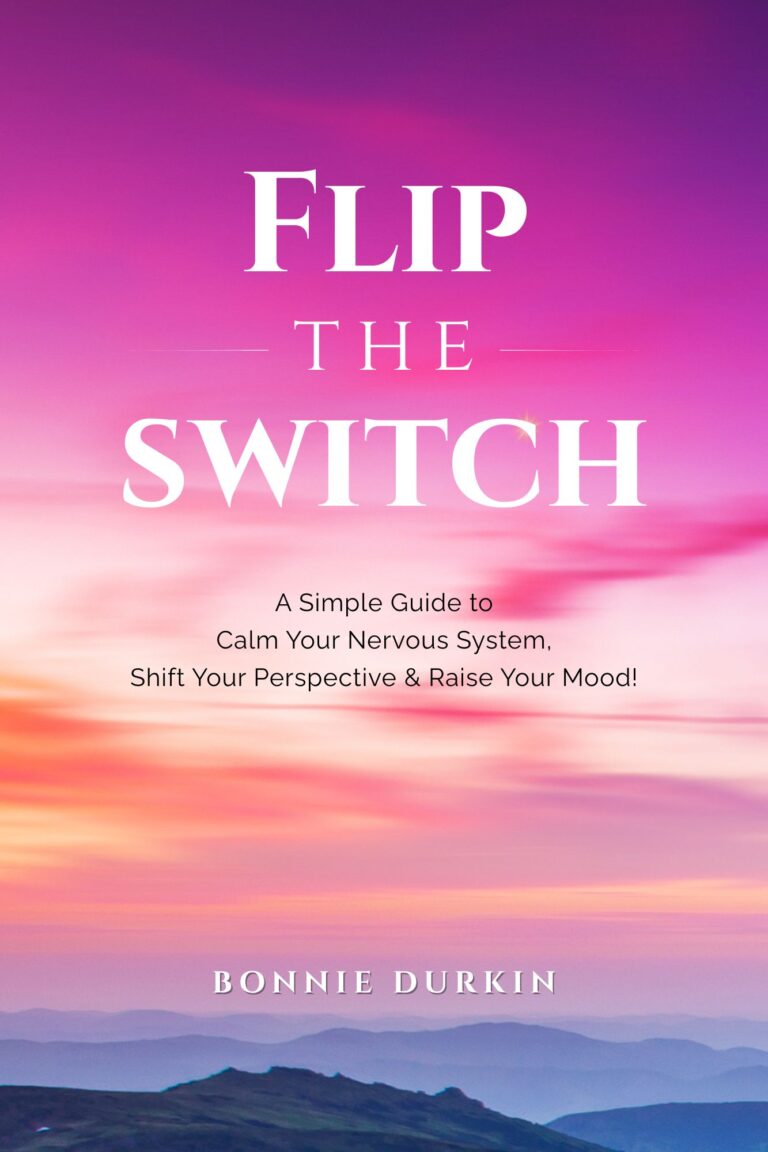
Flip the Switch
Available Now!
A practical guide to regulating your nervous system and shifting your perspective — so you can choose your response and elevate your mood.
Small shifts. Powerful change.
What Readers Are Saying
Flip the Switch is a delightful blend of warmth, encouragement, and practical tools to calm the nervous system and shift your perspective. Bonnie’s bubbly, uplifting spirit shines through every page. She shares simple ideas that may seem small at first but have a way of working their way into your life and becoming tools you return to again and again. This book is a wonderful toolbox to help you shift your state and feel better, one small step at a time.— Robin Friedman, Integrative Energy Practitioner and author of The Energy of Abundance
*****
“When I started Flip the Switch, I was flooded with negative thoughts. Over the 30 days, my thinking became much more positive, I felt far less affected by other people’s negativity and I feel more confident. Now when I find myself spiraling downward, I reach for one of the tools. This transformative 30-days gave me a powerful realization: when you have the right tools, positive thoughts really are a choice. The toolbox Bonnie gave us made all the difference, and I am so grateful.” – RW”
*****
“Bonnie is one of the sincerest people I have ever worked with. Her guidance and self-regulating tools have helped calm me through difficult moments. Recently I woke up from a nightmare with my body shaking. I remembered the finger-holding technique she teaches in the book. I was so anxious I couldn’t remember which finger to hold, so I held them all — including my thumb for anxiety. Within minutes my body calmed and I was able to fall back asleep. WOW!” — L.D.
Ready to Flip the Switch?
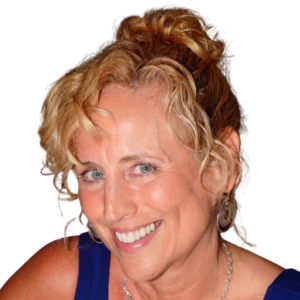
Bonnie Durkin is an author and Emotional Alignment Coach who helps people understand the powerful connection between their thoughts, their nervous system, and their daily experience.
With more than 22 years of experience in personal growth, EFT tapping, nervous system regulation, and mindset work, she shares practical tools that help people feel a little better — emotionally and physically — one small shift at a time.
Her work is rooted in self-empowerment and the belief that every person already holds the power within them to thrive. When you learn to regulate your body and consciously choose your thoughts, something shifts — not just in how you feel, but in how you live. You begin to step into a life that feels intentional, aligned, and truly your own. Small shifts truly create powerful change.